AI Agents vs Traditional Automation: What Works in 2026?
An AI agent is not automatically the best solution to a business problem. The better choice depends on how predictable the workflow is, how often exceptions occur, and whether the system can safely make decisions without human intervention.
Khalil Ur Rehman
Author
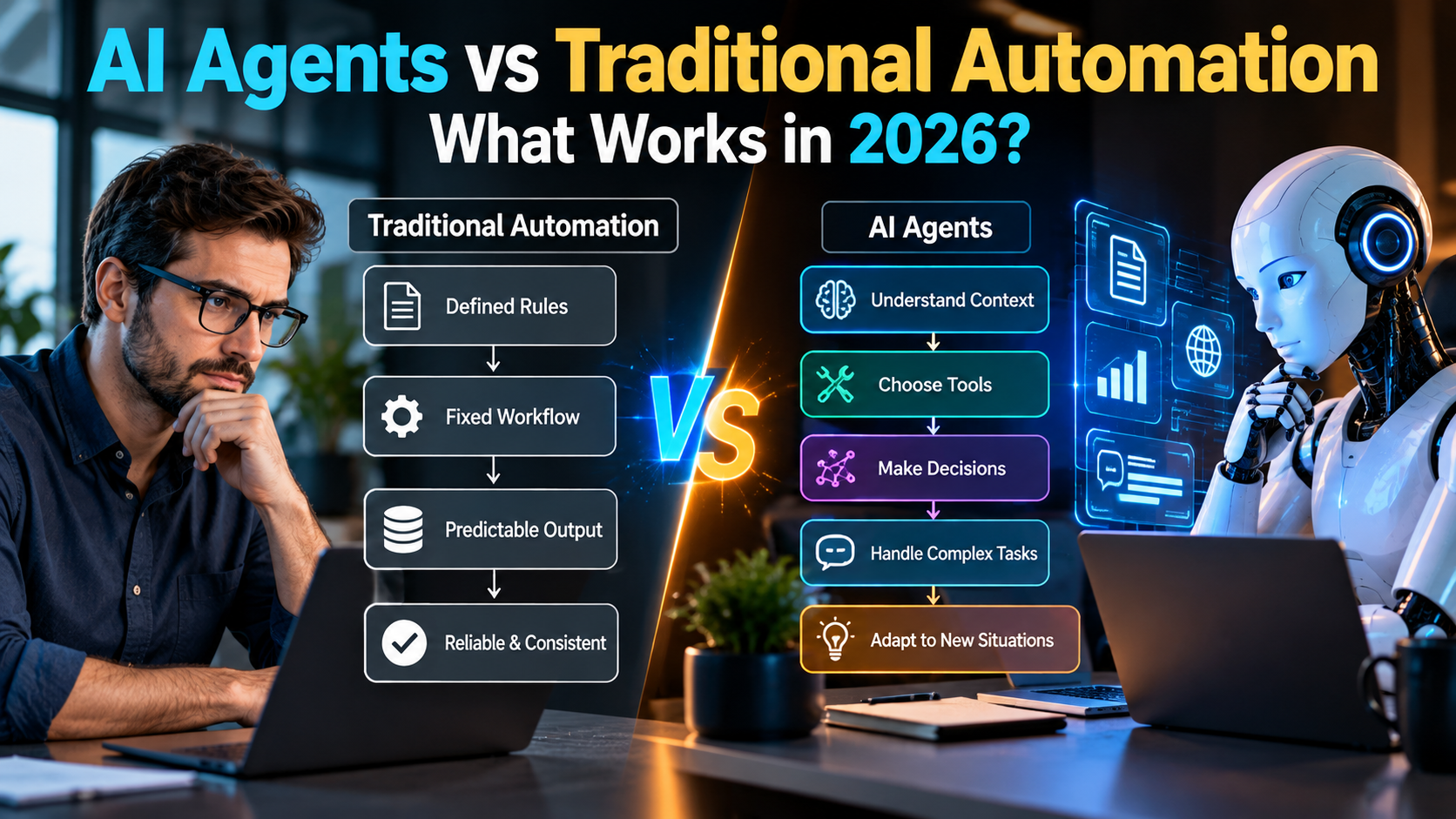
AI Agents vs Traditional Automation: What Works in 2026?
Artificial intelligence is changing how businesses think about automation. Tasks that once required rigid scripts, scheduled jobs, or robotic process automation (RPA) can now be handled by systems that interpret information, choose tools, and respond to unfamiliar situations.
That sounds like a major improvement. In some cases, it is.
But there is a question that often gets overlooked when companies begin exploring AI agents: Does this process actually need artificial intelligence?
Consider a business that receives hundreds of customer requests every day. Some requests involve straightforward actions, such as checking an order status or updating a delivery address. Others require interpreting unclear messages, examining documents, or deciding which department should investigate a problem.
Traditional automation can handle many of these activities efficiently. AI agents may be better suited to the less predictable work.
The challenge is knowing where one approach ends and the other begins.
For engineering teams in 2026, the objective should not be to replace every automated workflow with an AI agent. It should be to build systems that deliver reliable results at a reasonable cost, with appropriate security and human oversight.
1. The Real Difference Between AI Agents and Traditional Automation
Traditional automation follows instructions defined in advance.
A developer creates a workflow, specifies the conditions, and determines what the system should do when those conditions are met.
For example, an automated invoice-processing system might:
Receive an invoice through an API.
Extract fields from structured data.
Validate the invoice number and supplier ID.
Check the amount against a purchase order.
Send the invoice for approval if it exceeds a predefined threshold.
Record the outcome in an accounting system.
Every decision follows a known rule.
AI agents introduce a different capability.
An agent can interpret a goal, examine available information, select an appropriate tool, and determine the next action based on its observations.
Instead of requiring a separate rule for every possible wording of a customer request, an AI agent might identify the customer's intention and recommend a suitable workflow.
However, this flexibility introduces uncertainty.
Traditional code can usually be tested against clearly defined inputs and expected outputs. AI-generated decisions require additional evaluation because responses may vary even when the underlying business request is similar.
The practical distinction is not simply intelligence versus automation. It is predictable execution versus interpretation under uncertainty.
2. Why Traditional Automation Still Matters in 2026
AI agents receive considerable attention, but conventional automation remains essential to modern software infrastructure.
A payment processor, for example, should not ask a language model whether a valid transaction needs to be recorded. The application should execute a deterministic transaction with explicit validation and error handling.
The same principle applies to many everyday operations.
Traditional automation remains a strong choice when:
Input data follows a consistent structure.
Business rules are stable and clearly documented.
The same action must produce a predictable result.
Execution speed and operating cost are important.
Auditability and regulatory controls are required.
Failures must be easy to reproduce and investigate.
Consider a company that needs to generate a daily sales report.
If all the necessary information exists in a database, a scheduled SQL query and a reporting script may be sufficient.
Introducing an AI agent to retrieve the same numbers could add model costs, latency, and another potential failure point without improving the outcome.
This does not mean AI has no role in reporting. An AI system might help explain unusual sales patterns or answer questions about the results.
But the calculation of revenue, taxes, and financial totals should remain grounded in validated data and deterministic logic.
3. Where AI Agents Can Deliver Genuine Value
AI agents become more useful when a workflow involves interpretation, changing context, or information that cannot be handled easily through fixed rules.
Imagine an IT support team receiving the following message:
"My application was working yesterday, but now I cannot access the dashboard. I recently changed my password, and I am not sure whether that caused the problem."
A traditional keyword-based workflow might struggle to determine whether this is a password issue, an application outage, or a permissions problem.
An AI-assisted workflow could:
Interpret the user's description.
Identify possible authentication or authorization problems.
Search approved internal troubleshooting documentation.
Check permitted service-health information.
Suggest diagnostic steps.
Prepare a support ticket with relevant context.
Escalate the issue when evidence is insufficient.
The value comes from connecting information that would otherwise require manual interpretation.
Even here, the agent should not automatically reset accounts, change permissions, or execute administrative commands without suitable authorization.
A useful design separates the agent's ability to interpret a situation from its authority to change production systems.
4. A Practical Example: Automating Customer Support Requests
Consider a company that receives customer requests through a web form.
The objective is to classify each request and route it to the appropriate team.
Approach A: Traditional rule-based automation
A simple Python implementation might look like this:
def route_request(message):
    text = message.lower()

    if "refund" in text:
        return "billing"

    if "password" in text:
        return "account_support"

    if "delivery" in text:
        return "logistics"

    return "manual_review"
This implementation is easy to understand and inexpensive to execute.
For example:
print(route_request(
    "I need a refund for my order"
))
Expected output:
billingThe limitation becomes apparent when customers describe the same issue differently.
Consider:
I was charged twice for the same purchase.The function returns:
manual_reviewThe message concerns billing, but the rule only looks for the word "refund."
Developers can add more keywords, regular expressions, and business rules. For a small number of well-defined categories, that may be the most practical solution.
As language variations increase, however, maintaining the rules becomes more difficult.
Approach B: AI-assisted classification
An AI-assisted system can classify requests according to their meaning rather than relying entirely on keywords.
A possible classification instruction is:
Classify the customer request into one category:

- billing
- account_support
- logistics
- manual_review

Return only a valid category.

If the request is ambiguous, return manual_review.

Do not perform any customer account changes.
For the earlier example:
I was charged twice for the same purchase.The intended classification would be:
billingThis illustrates the benefit of semantic interpretation, but it does not prove that an AI model will always classify the request correctly.
The actual result depends on the selected model, prompt, available context, and evaluation data.
Add deterministic validation
Even when AI performs the classification, the application should validate the output before using it.
ALLOWED_TEAMS = {
    "billing",
    "account_support",
    "logistics",
    "manual_review"
}

def validate_ai_route(candidate):
    if not isinstance(candidate, str):
        return "manual_review"

    route = candidate.strip().lower()

    if route not in ALLOWED_TEAMS:
        return "manual_review"

    return route
This function prevents an unexpected model response from becoming an arbitrary routing destination.
For example:
print(validate_ai_route("billing"))
print(validate_ai_route("unknown_team"))
Expected output:
billing
manual_review
This is an important engineering boundary.
The AI component interprets the request. Traditional application code enforces the permitted outcomes.
In a production environment, the system would also need authentication, logging, monitoring, privacy controls, and safeguards against malicious input.
The example demonstrates an architectural pattern, not a completed production deployment or measured comparison.
5. Why a Hybrid Architecture Often Makes More Sense
Many businesses frame the decision as a choice between traditional automation and AI agents.
In practice, combining them can be more effective.
Consider an invoice-processing workflow.
A conventional application can validate supplier identifiers, check purchase-order totals, and enforce approval thresholds.
An AI component can help interpret unstructured supporting documents or explain why an invoice appears inconsistent with a purchase order.
The workflow might operate as follows:
A document-processing service receives an invoice.
Deterministic validation checks required fields.
An AI component interprets ambiguous descriptions when necessary.
Business rules determine whether the invoice qualifies for automatic processing.
A human reviewer handles uncertain or high-risk cases.
The accounting system records the approved transaction.
The AI component does not need unrestricted access to the accounting database.
It only needs the information and tools required for its assigned task.
This design reduces unnecessary AI calls while keeping critical financial decisions under explicit controls.
It also makes failures easier to investigate because the responsibilities of each component are clearly defined.
6. The Hidden Costs of AI Agent Automation
A common mistake is comparing the cost of writing a script with the price of a single AI model request.
That comparison ignores the operating costs of the complete system.
AI agent expenses can include:
Input and output token usage.
Multiple model calls for a single task.
Retrieval and database operations.
External API requests.
Monitoring and evaluation infrastructure.
Retry attempts after failed responses.
Human review and escalation.
Security testing and incident investigation.
An agent that performs several reasoning and tool-execution steps may cost considerably more than a simple classification request.
Traditional automation also has costs, particularly when business rules change frequently or exceptions require extensive manual handling.
A useful comparison therefore considers the total cost per successfully completed workflow.
One possible metric is:
Cost per successful task =
Total operating cost / Successful tasks
For example, a team could compare two implementations over the same set of support requests.
The evaluation should measure:
Correct classification rate.
Average processing time.
Cost per successfully routed request.
Number of cases requiring manual review.
Frequency of invalid or unsafe outputs.
Maintenance effort when categories change.
Without those measurements, claims that AI agents are cheaper or more productive remain assumptions.
7. Reliability Matters More Than Impressive Demonstrations
AI agents often perform well in carefully prepared demonstrations.
Production environments are less predictable.
Users submit incomplete information. External APIs become unavailable. Documents contain contradictory instructions. Tools return unexpected responses.
An AI agent may also select the wrong tool or misunderstand the result of an earlier action.
This creates several engineering requirements.
First, validate tool inputs. An agent should not be able to submit arbitrary commands or unvalidated parameters to sensitive systems.
Second, limit permissions. Give the agent access only to the operations required for its task.
Third, establish retry limits. An agent should not repeatedly call a failing service without a defined stopping condition.
Fourth, preserve audit records. Important decisions and tool actions should be traceable.
Finally, define a safe failure path. When the system cannot make a reliable decision, it should escalate rather than invent an answer or perform an unauthorized action.
For high-impact workflows, human approval should be part of the architecture rather than an afterthought.
8. Security Risks Businesses Should Consider
Traditional automation and AI agents share many security concerns, including credential management, access control, and API security.
AI agents introduce additional risks because they may interpret untrusted content as part of their workflow.
For example, a support agent might retrieve a customer-submitted document containing instructions that attempt to override its intended behavior.
This is a form of prompt injection.
An attacker could try to persuade the agent to disclose information, call an unauthorized tool, or ignore its operating instructions.
Practical safeguards include:
Treating retrieved documents and user messages as untrusted data.
Separating system instructions from external content.
Restricting tool permissions and accessible resources.
Validating tool arguments before execution.
Requiring approval for sensitive operations.
Testing malicious and ambiguous inputs.
Recording security-relevant tool activity.
The OWASP guidance on LLM application security provides useful background on these risks.
However, no single prompt or instruction can guarantee that an agent will behave securely.
Security must be enforced by the surrounding application architecture.
9. How to Decide Whether a Business Process Needs an AI Agent
Before introducing an AI agent, engineering teams should answer a few practical questions.
Is the workflow predictable?
If inputs and outputs follow stable rules, traditional automation is usually the simpler starting point.
Does the task require interpreting unstructured information?
If users submit free-form messages, documents, or complex requests, an AI component may offer meaningful benefits.
Can an incorrect decision cause financial or operational harm?
The higher the impact of an error, the stronger the need for deterministic controls and human oversight.
How frequently does the workflow change?
If rules change regularly, maintaining a large decision tree may become expensive. AI-assisted interpretation may reduce some maintenance work, although model evaluation and monitoring introduce their own responsibilities.
Can success be measured?
Before deployment, define what a successful outcome looks like.
For customer support, that might mean correct routing, reduced resolution time, and fewer unnecessary escalations.
For document processing, it might mean extraction accuracy, review time, and exception rates.
Without measurable outcomes, it is difficult to determine whether the AI implementation provides genuine value.
10. A Sensible Adoption Strategy for 2026
Businesses do not need to replace their existing automation platforms to benefit from AI.
A safer approach is to introduce AI gradually.
Start with a narrow workflow that already has a measurable baseline.
For example, select one category of customer support requests and compare a rule-based classifier with an AI-assisted alternative.
Use the same representative evaluation dataset for both systems.
Review incorrect classifications, operating costs, response times, and escalation rates.
If the AI-assisted approach performs better under acceptable cost and risk constraints, expand it carefully.
If traditional automation delivers equivalent results with lower complexity, keep the existing implementation.
The objective is not to maximize the number of AI agents in production.
It is to improve the business process.
Final Thoughts
AI agents are an important development in business automation, but they are not a universal replacement for scripts, APIs, workflow engines, or RPA systems.
Traditional automation remains valuable because it is predictable, efficient, and relatively straightforward to validate.
AI agents offer additional flexibility when tasks require interpretation, context, and adaptation to unfamiliar situations.
For many organizations, the strongest architecture will combine both approaches.
Let AI interpret information where flexibility is useful. Let deterministic software enforce rules, validate outputs, and execute sensitive operations under appropriate controls.
In 2026, the more useful question is not whether a business should adopt AI agents.
It is whether an AI agent can improve a specific workflow enough to justify its additional cost, complexity, and risk.
That is the decision engineering teams should be prepared to measure.
References and Further Reading
OWASP Top 10 for Large Language Model Applications — Security risks and mitigation guidance for LLM-powered systems.
NIST AI Risk Management Framework — Guidance for managing AI-related risks.
Microsoft Power Automate Documentation — Conventional workflow automation and RPA capabilities.
Python Documentation — Language reference for the reproducible classification and validation examples.