Reduce AI Agent Token Costs in 2026: 10 Proven Tips
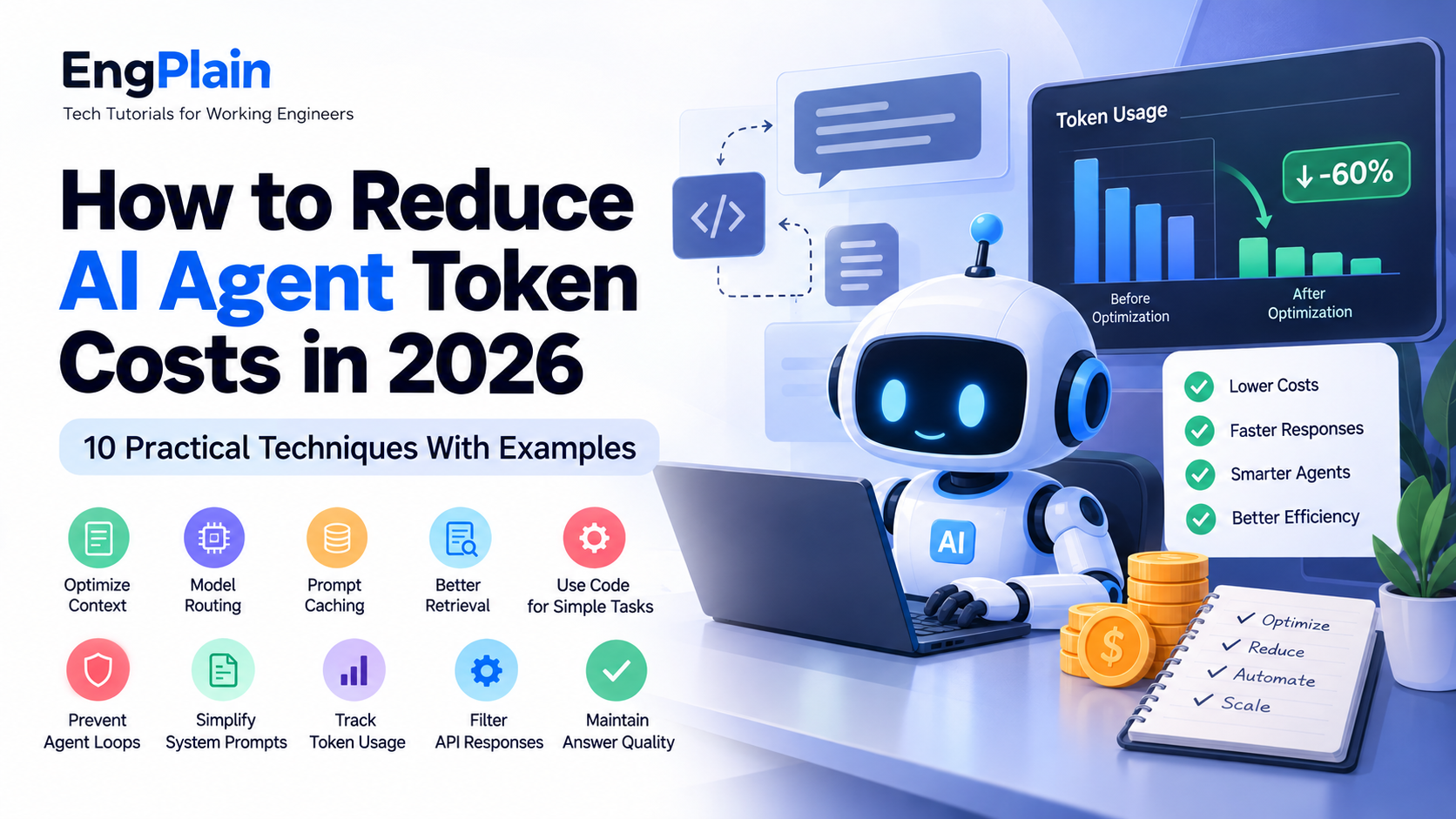
An AI agent can spend more money processing repeated instructions and oversized tool responses than completing the task itself. These ten engineering techniques show where to reduce that overhead, what can go wrong, and how to judge whether an optimization is worth deploying.
Khalil Ur Rehman
Author
Introduction: Why AI Agent Costs Can Grow Faster Than Expected
Artificial intelligence agents are becoming increasingly useful for software development, customer support, data analysis, and business automation. Unlike a simple chatbot, an AI agent may perform several operations before completing a single task.
It might search a database, retrieve documents, call external APIs, analyze information, and generate a final response.
Every model request consumes tokens, and those tokens contribute to operating costs.
For developers managing hundreds or thousands of agent interactions, unnecessary token consumption can become a serious financial and engineering concern.
The challenge is not simply making prompts shorter. It is designing an agent that uses the information and computational resources it actually needs.
Here are ten practical techniques that can help.
1. Reduce Unnecessary Conversation History
One common reason AI agents consume excessive tokens is that applications repeatedly send the entire conversation history to the model.
Consider an AI customer-support assistant that has exchanged 40 messages with a customer. If the application includes all 40 messages in every new request, the model repeatedly processes information that may no longer be relevant.
How to improve it:
Keep recent messages directly related to the current task.
Summarize older conversations while preserving important facts.
Store persistent information, such as customer preferences, separately.
Remove duplicated explanations and completed discussion threads.
Preserve unresolved issues and earlier commitments.
For example, rather than passing an entire conversation about a delayed delivery, the application might provide the order number, current delivery status, and customer's outstanding question.
Potential failure: An overly aggressive summary could remove a previously approved refund exception or another important commitment.
Engineering recommendation: Preserve essential facts as structured state and evaluate whether the agent still answers correctly after reducing context.
2. Choose the Right AI Model for Each Task
Using a highly capable reasoning model for every operation can create unnecessary expenses.
Some tasks require complex analysis. Others involve straightforward classification, extraction, or formatting.
A practical solution is model routing, where the application selects a model according to task complexity.
Examples of task-based routing:
Simple data extraction: Use a smaller, lower-cost model or deterministic code.
Customer inquiry classification: Use a smaller model with output validation.
Routine summaries: Consider a lower-cost model.
Complex debugging: Use a more capable reasoning model.
Security-sensitive analysis: Use an appropriately evaluated model with additional checks.
However, choosing a cheaper model does not guarantee lower total costs.
If a smaller model produces incorrect responses and requires multiple retries, the savings may disappear.
Engineering recommendation: Compare the total cost per successfully completed task, including retries and validation, rather than comparing model prices alone.
3. Filter API Responses Before Sending Them to the AI Agent
External APIs often return much more information than an agent needs.
An order-management API, for example, might return customer details, shipping information, payment references, internal notes, and transaction metadata.
If the agent only needs to answer a delivery-status question, most of those fields are unnecessary.
Instead of passing the entire response to the model, filter the data in Python.
Practical Python Example
import json

order = {
    "order_id": "ORD-1042",
    "customer_name": "Example Customer",
    "status": "shipped",
    "estimated_delivery": "2026-10-12",
    "shipping_address": "Example Address",
    "internal_notes": "Operations information",
    "payment_reference": "PAY-1042"
}

filtered_order = {
    "order_id": order["order_id"],
    "status": order["status"],
    "estimated_delivery": order["estimated_delivery"]
}

print(json.dumps(filtered_order, indent=2))
Benefits of filtering:
Reduces unnecessary context.
Limits exposure of unrelated customer information.
Makes tool responses easier for the agent to interpret.
Helps developers maintain predictable input structures.
Potential failure: Removing a required field can cause an incomplete or incorrect answer.
Engineering recommendation: Define task-specific response schemas rather than removing fields arbitrarily.
4. Use Prompt Caching for Repeated Information
Many AI applications repeatedly send identical instructions or reference materials.
Examples include system instructions, tool definitions, company policies, and stable product documentation.
Prompt caching can reduce the cost of processing repeated content when the model provider supports it.
There are two important approaches.
Provider-level prompt caching
Reuses eligible prompt content according to the provider's caching rules.
May reduce the billed cost of repeated input tokens.
Depends on model support, cache eligibility, and provider pricing.
Application-level caching
Stores reusable results within the application.
Can prevent unnecessary retrieval operations or model requests.
Requires careful handling of expiration and changing information.
For example, an agent repeatedly consulting an unchanged product manual may benefit from a caching strategy.
Potential failure: Cached information can become outdated when policies, product versions, or customer records change.
Engineering recommendation: Establish expiration rules and invalidate cached information when its underlying source changes.
5. Optimize Document Retrieval in RAG Applications
Retrieval-augmented generation, commonly called RAG, allows AI applications to answer questions using external documents.
However, poorly configured retrieval systems can send excessive amounts of information to the model.
Imagine a developer asking how to configure a Kubernetes readiness probe. A retrieval system might return multiple lengthy infrastructure documents, even though only a few sections are relevant.
Ways to improve retrieval efficiency:
Retrieve a smaller number of highly relevant passages.
Filter documents by product version or topic.
Remove duplicate passages.
Use reranking when the additional processing is justified.
Expand retrieved context only when necessary.
Reducing retrieved content can lower input token usage, but retrieval quality matters more than document count.
Potential failure: Important configuration details or exceptions may disappear when retrieval is too restrictive.
Engineering recommendation: Test retrieval against questions with known answers and verify that the necessary evidence remains available.
6. Replace Simple AI Operations With Traditional Python Code
Not every operation needs artificial intelligence.
Some tasks can be completed more predictably using conventional programming.
Examples include:
Mathematical calculations.
Date formatting.
JSON validation.
Currency conversions using supplied rates.
Basic string processing.
Checking predefined business rules.
Python Example: Calculate an Order Total
from decimal import Decimal

items = [
    {"price": "25.00", "quantity": 2},
    {"price": "15.00", "quantity": 3}
]

total = sum(
    (
        Decimal(item["price"]) * item["quantity"]
        for item in items
    ),
    Decimal("0.00")
)

print(f"Order total: ${total:.2f}")
Expected output:Order total: $95.00A language model is unnecessary for this calculation.
Using deterministic code for predictable operations can also improve consistency and make failures easier to investigate.
Engineering recommendation: Reserve AI model calls for tasks involving interpretation, ambiguity, language understanding, or complex reasoning.
7. Prevent Repeated Tool Calls and Uncontrolled Agent Loops
AI agents sometimes enter repetitive execution cycles.
A coding agent might run a test, encounter an error, modify a file, and run the same test repeatedly without resolving the underlying issue.
Every additional model request can consume more tokens.
Practical safeguards include:
Setting maximum model-call limits per task.
Restricting repeated tool calls.
Introducing execution timeouts.
Establishing token or cost budgets.
Detecting repeated errors.
Escalating unresolved tasks for review.
For example, if an API repeatedly returns an authorization error, the agent should recognize that further attempts may not help until the permissions issue is resolved.
Potential failure: Limits that are too restrictive may stop legitimate complex tasks before completion.
Engineering recommendation: Establish different budgets for simple requests and complex workflows.
8. Simplify and Maintain System Prompts
System prompts often become unnecessarily long because teams keep adding instructions whenever an agent makes a mistake.
Over time, those instructions can become repetitive, contradictory, or outdated.
Longer prompts are not automatically more reliable.
Review system prompts for:
Duplicate requirements.
Conflicting instructions.
Unnecessary examples.
Outdated workflow descriptions.
Formatting requirements better enforced in code.
Instructions that belong in tool definitions.
For example, if an application requires valid JSON, structured output support and programmatic validation may be more dependable than repeatedly adding formatting reminders.
Potential failure: Removing an important safety or authorization instruction can weaken the system.
Engineering recommendation: Version system prompts and review changes using representative tasks before deployment.
9. Track Token Usage and Estimate API Costs
Developers cannot reliably optimize expenses without understanding where those expenses originate.
A complete AI workflow may involve several model requests, cached inputs, external tools, and retries.
Monitoring should therefore happen at both the request level and the task level.
Important metrics to collect:
Input tokens.
Output tokens.
Cached input tokens, when reported.
Model name.
Number of model requests.
Tool calls and retries.
Task completion status.
Estimated total API cost.
Python Example: Calculate Estimated Token Costs
The following example uses illustrative rates rather than current pricing for a particular model.
def calculate_cost(
    input_tokens,
    output_tokens,
    input_price_per_million,
    output_price_per_million
):
    input_cost = (
        input_tokens / 1_000_000
    ) * input_price_per_million

    output_cost = (
        output_tokens / 1_000_000
    ) * output_price_per_million

    return input_cost + output_cost


cost = calculate_cost(
    input_tokens=12000,
    output_tokens=2000,
    input_price_per_million=1.00,
    output_price_per_million=4.00
)

print(f"Estimated cost: ${cost:.4f}")
Expected output:
Estimated cost: $0.0200The figures demonstrate the calculation method only. They are not measurements from a real agent experiment.
Actual billing may also involve cached-token rates, tool charges, and other provider-specific fees.
Engineering recommendation: Track the total cost per successful task rather than focusing exclusively on tokens per request.
10. Balance Token Savings With Answer Quality
An optimization that reduces token usage but causes incorrect answers is not necessarily an improvement.
Consider a customer-support agent processing a refund request.
The original context includes:
The customer received the order 35 days ago.
The standard refund window is 30 days.
The customer received an approved exception extending the window to 45 days.
If context trimming removes the exception, the agent may incorrectly deny the refund.
This is an illustrative failure scenario, not a reproduced production incident.
The example shows why relevant context must be preserved even when reducing token consumption.
Questions to ask before accepting an optimization:
Does the agent still complete the task correctly?
Does it require additional retries?
Are tool calls increasing or decreasing?
Is response time improving?
Are important facts missing?
Is the total cost per successful task actually lower?
Engineering recommendation: Reject optimizations that create unacceptable reliability problems, even when they reduce input token counts.
Where Should Developers Start?
Trying to implement every optimization simultaneously can make it difficult to understand which change improved performance.
A more manageable approach is to introduce improvements gradually.
First priority: Remove unnecessary tool data
Filter irrelevant API fields before sending responses to the model. This is often straightforward to implement and review.
Second priority: Identify repeated model calls
Inspect agent traces to find duplicated requests, unnecessary retries, and operations that could be handled without a language model.
Third priority: Use deterministic code
Move calculations, validation, and predictable data transformations into standard application logic.
Fourth priority: Evaluate model routing
Test whether simpler tasks can use lower-cost models without unacceptable changes in accuracy or reliability.
Fifth priority: Improve memory and retrieval
Optimize conversation summaries and document retrieval once appropriate quality checks are available.
This sequence is a practical starting recommendation, not a universal ranking of potential savings.
Final Thoughts
Reducing AI agent token costs is not simply about writing shorter prompts or choosing the cheapest available model.
It requires understanding how information moves through the entire workflow.
Repeated conversation history, oversized tool responses, unnecessary model calls, inefficient retrieval, and uncontrolled execution loops can all contribute to avoidable expenses.
The most effective approach is to remove unnecessary work while preserving the information and capabilities needed for correct results.
For engineers building production AI systems, the objective should be clear:
Reduce the total cost of completing a task successfully, without compromising reliability, security, or maintainability.
References and Further Reading
OpenAI API Pricing — Current pricing and billing details.
OpenAI Prompt Caching — Prompt caching behavior and implementation.
OpenAI API Reference — API requests and usage information.
Anthropic Prompt Caching — Prompt caching guidance for Claude.