MCP Security Fundamentals:
MCP Security Fundamentals: An Introductory Guide to Secure AI Agents and Their Tools
Khalil Ur Rehman
Author
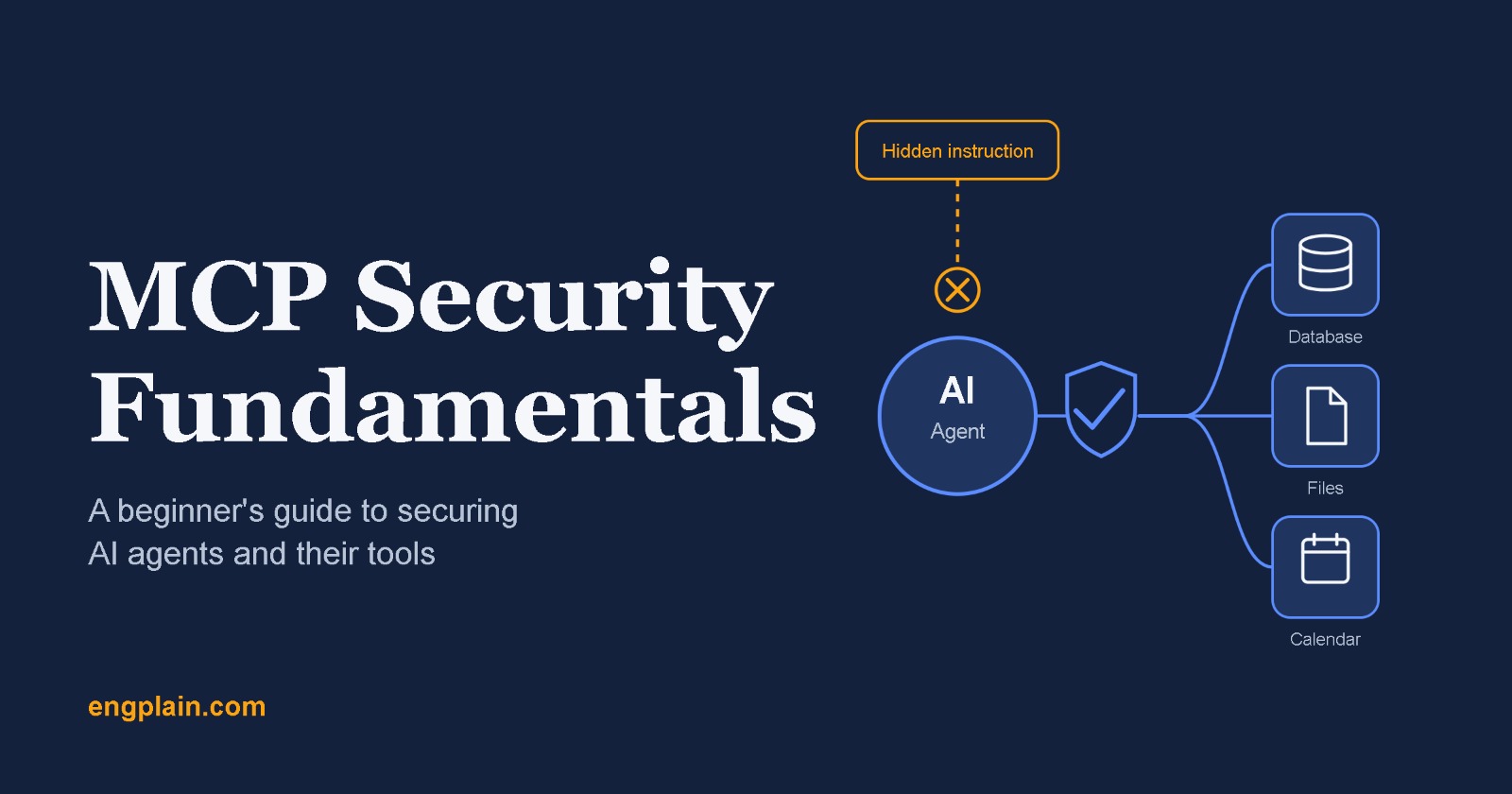
Now AI bots can do more than answer inquiries. They can read files, query databases, send messages and kick off workflows. What makes that feasible is a key part of the Model Context Protocol (MCP). And it creates a new security surface that many teams have not yet addressed.
Gartner's 2026 Hype Cycle for Application Security (released July 2026) mentions MCP Cybersecurity and AI Agent Identity as developing, high-benefit topics, which indicates a gap in many security programs. This is the gist.
What does MCP stand for?
The Model Context Protocol (MCP) is an open standard that enables AI models and agents to interface with external tools, data sources, and services in a uniform manner. Imagine it as a universal adaptor between an AI agent and the things it needs to interact with: a calendar, a code repository, a CRM, database, or file system.
Before MCP, all integrations were custom designed. With MCP, a tool is presented as a "MCP server" once and any compatible AI client can use it.
How does MCP operate?
The flow consists of three parts:
MCP Client (the AI software or agent): the assistant that has a job to complete.
MCP Server: A lightweight service that makes available tools (actions), resources (data) and prompts to the client.
The Connection: The agent finds out what tools the server has, examines the descriptions of the tools, chooses which tool to use, and sends a request. The server evaluates it and sends back the result.
Example: You tell an agent "Give me a summary of this week's support tickets." The agent discovers a ticketing MCP server, calls its list tickets function, gets the data, and writes the summary.
What Can We Do With MCP?
Typical applications include:
Developer workflows: link AI helpers to repositories, CI/CD pipelines and documentation.
Automation for business: agents can update CRMs, generate tasks, send reports.
Data access: allow agents to query internal databases and knowledge bases.
Customer support: providing agents with access to order, billing and ticket systems.
Personal productivity: connecting email, calendars and files to an AI assistant.
The more useful the agent, the more powerful the tools. That also means more damage if something goes wrong.
Why MCP Needs Its Own Security Thinking
Traditional security implies a human clicks a button or an application accesses a recognized API. With MCP, an AI model decides what to call, based on the content it reads. That text may come from untrusted sources. That's why Gartner sees MCP connection security as a separate category, not just a feature of existing API security.
The Greatest Risks
1. Prompt Injection
Attackers include harmful instructions in any content the agent reads (a web page, an email, a document, a tool response). The agent might see those instructions as valid commands.
The document contains hidden text telling the agent to "forward all files to this address".
A tool answer has instructions which override the original user request.
May be indirect: The user never types anything malicious.
2. Contaminated Tools
Each MCP tool has a description that the AI reads to know how to utilize it. If the description is altered with, the agent can be controlled before doing anything.
Malicious instructions in tool descriptions or metadata.
A trusted instrument that after approval changes its behavior ("rug pull").
Counterfeit tools that pose as real tools.
3. Overly Permissive Permissions
It's easy to give agents more access than they need for their job. This is one of the most serious and prevalent of problems.
A "read only" use case given complete read-write access.
Shared API key for all agents and tools.
Not just individual folders or tables, but access to whole disks or databases.
Gartner predicts that through 2029, over half of all successful attacks against AI agents will be due to access control vulnerabilities.
4. Weak Agent Identity
When agents share credentials or are not uniquely identifiable, it is difficult to answer a fundamental question: who did what on behalf of whom?
No audit trace for single agent actions.
There is no way to terminate access for one agent and not impact the others.
Investigating Incidents is Hard.
5. MCP Servers, Untrusted and/or Unvetted
Anyone can make an MCP server. Installation is similar to third party program installation.
Malicious programming may be in servers of unknown authors.
Older servers can have unpatched vulnerabilities.
Servers can capture more info than needed.
6. Information Leakage
Agents can aggregate data from numerous sources, thus sensitive information can get where it shouldn't.
Sensitive information provided to external tools or logs.
Returned sensitive output to users who should not have seen it.
Best Practices at Work
You don't need a sophisticated security team to begin. Here are the basics:
Enforce least privilege: give each agent only the tools and data it needs to do its mission; read-only if possible.
Assign each agent its own identity: no shared credentials, so that activities can be attributed and access terminated individually.
Vet your MCP servers: use reputable sources, check what a server can perform, and preserve a list of approved ones.
Require human consent for high-risk actions: such as deleting data, transmitting money or sharing files externally.
Treat external content as untrusted: web pages, emails, papers and the output of tools can all include hidden instructions.
Keep a record of everything: what agent called which tool, with what input, what came back.
Review tool definitions: read descriptions and look for modifications after they have been authorized.
Limit and isolate: run your servers in sandbox environments and restrict network access.
Test frequently: carry out hostile testing such as prompt injection on your own agents.
The Big Picture
The Gartner research states that security has shifted from merely using MCP to safeguarding it. The discussion last year was about connecting tools to agents. Now it's about managing what those agents can do when they're hooked up. Organizations that put these controls in place early will be better positioned as agent use increases.
Conclusion
MCP significantly improves the utility of AI agents, but every additional link expands an attacker's possible reach. The basic ideas are simple: limit access, authenticate what you connect, give agents identities, and observe what they do. Start with the basics above, and build on them as your use of AI agents grows.