Article
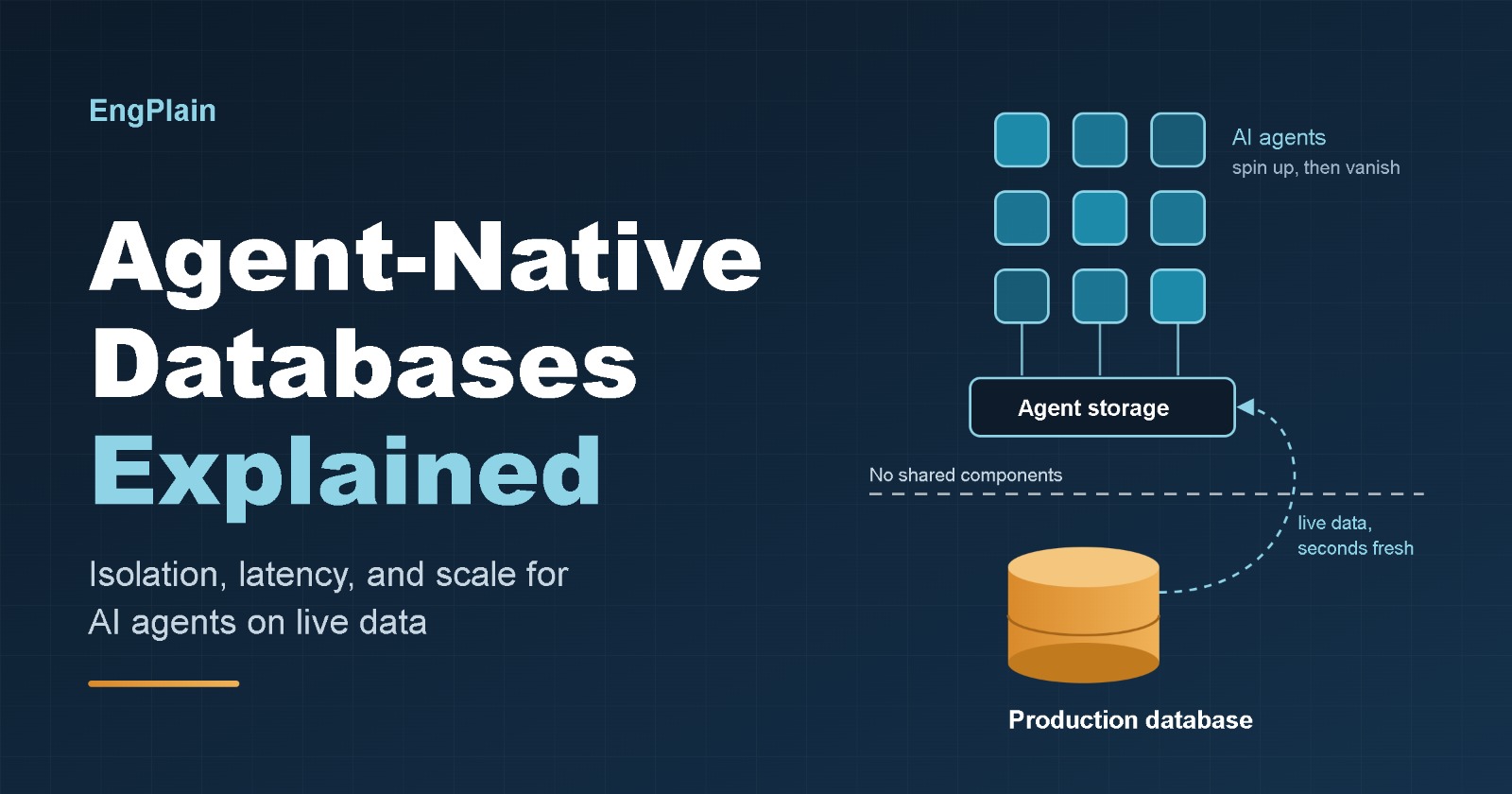
Agent-Native Databases Explained
Agent-Native Databases Explained: Isolation, Latency, and Scale
AI agents want to query live production data. Production databases were never designed to be queried by thousands of unpredictable readers at once. Here is what that gap looks like, and how one vendor claims to close it.
The short version
The problem: agents generate queries on the fly, in bursts, and nobody can review them in advance. Pointed at a production database, they can slow down or knock over the system that runs the business.
The proposal: Google Cloud argues an "agentic" database must deliver three things together: isolation, sub-millisecond latency, and burst scale.
The claim: existing designs (replicas, shared storage, object storage with a cache) each give up at least one. Google says its new AlloyDB architecture gives up none.
The caveat: the numbers come from the vendor's own tests, and the feature is in preview. Treat it as a strong idea worth evaluating, not a settled result.
Why agents are a different kind of database client
For about forty years, the people who query a database were mostly predictable. Applications ran a known set of queries. Analysts ran reports on a schedule, often against a copy of the data. If a query was expensive, someone reviewed it.
Agents break each of those assumptions:
Unvetted queries. An agent writes its SQL while it reasons. No one approved it beforehand.
Bursty load. One task may fan out into hundreds of parallel workers for a minute, then vanish.
Need for fresh data. Agents that act on stale copies make stale decisions, so a nightly export is not good enough.
Need for the full engine. Agents rely on indexes, joins, and vector, full-text, and spatial search inside every reasoning step. Scanning raw files is too slow.
Put together, you get a hard question: how do you let a swarm of unpredictable readers see live data without putting the system of record at risk?
The three properties an agent-ready database needs
The original announcement frames the answer as three requirements that must all hold at once. Here they are in plain terms.
1. Isolation
"Agents can read live data, but they cannot slow down production."
Agent traffic must not share database components with the primary system, including storage.
A usage quota is not enough. Shared resources mean shared failures.
Data still has to be fresh, meaning seconds old, not a stale snapshot or branch.
2. Latency
"Even a cache miss must be fast."
Operational workloads expect storage reads in under a millisecond.
Caches help hot data, but a miss that falls back to slow storage creates a performance cliff.
Agents run loops of "retrieve, think, retrieve again," so slow reads multiply quickly.
3. Scale
"Go from zero to thousands of workers in seconds, then back to zero."
Compute must start in seconds and stop when the agents finish.
Storage bandwidth must scale with it. More compute on a fixed storage tier just moves the bottleneck.
Pre-provisioning capacity for unpredictable bursts is wasteful and never quite right.
Why today's architectures fall short
The announcement groups existing operational databases into three families. Here is a summary of each, using the three properties as a scorecard.
Independent replicas
How it works: the primary streams its log to separate replicas, each with its own storage.
Strengths: excellent isolation and fast local reads.
Weakness: a new replica must copy hundreds of gigabytes or terabytes before it is useful. That takes hours, while an agent burst lasts seconds. You also pay for idle replicas.
Shared-storage servers
How it works: stateless compute nodes sit on top of one shared, multi-tenant storage tier. Examples include Aurora and Azure SQL Hyperscale.
Strengths: new read nodes start quickly because no data is copied. Reads are fast.
Weakness: the primary and every replica hit the same storage servers. Agent traffic competes with production traffic, and total I/O is capped by what the tier was provisioned for.
Object storage with a shared cache tier
How it works: data lives durably in object storage, and a tier of block servers caches hot data in front of it.
Strengths: cheap, durable storage and low latency for cached data.
Weakness: a cache miss goes to object storage, where random reads can take tens of milliseconds. The cache tier is shared with production, and it does not scale with a burst.
Independent replicas
Isolation: Yes
Latency: Yes
Burst scale: No. Hours to add a replica.
Shared-storage servers
Isolation: No. Shared fate.
Latency: Yes
Burst scale: No. Storage I/O is fixed.
Object storage + shared cache
Isolation: No. Shared cache tier.
Latency: Partly. Misses are slow.
Burst scale: No. Cache does not burst.
Google's proposed design
Isolation: Yes (claimed)
Latency: Yes (claimed)
Burst scale: Yes (claimed)
What Google announced: AlloyDB for agents
Google's answer is a new architecture for AlloyDB, its PostgreSQL-compatible database. The main idea is summed up in one line from the announcement: share the data, and share nothing else.
How it is built
Separate production cluster. The main database stays on dedicated, pre-provisioned infrastructure, exactly as before.
An ephemeral agent pool. Agents connect through the Model Context Protocol (MCP) to short-lived, read-only AlloyDB nodes. Each runs inside a lightweight microVM.
Separate storage segments. Agent nodes read directly from their own segments on Colossus, Google's distributed storage system, not from the production path.
Fast network. Google's Jupiter data-center network lets nodes be placed anywhere and still reach storage quickly.
Per-second billing. Agent nodes are billed while they run and stop when the task ends.
Full engine. Agents get real PostgreSQL: indexes, point lookups, vector, full-text, and spatial search, and federated queries into the lakehouse (BigQuery and Spark).
What the announcement leaves out
A vendor post is written to make one design look good. These are the questions it does not fully answer, and that you should ask of any agent-facing database.
Cost. Per-second billing sounds cheap, but 1,000 nodes for a minute is not free. Ask what a realistic month of bursts costs, including storage reads.
Read-only agents. The agent pool described here reads data. If your agents also write (update a ticket, place an order), that path still goes through production and needs its own guardrails.
Freshness under load. "Sub-second freshness" is a target. Ask how replication lag behaves during a heavy write period on the primary.
Lock-in. This design depends on Google's own storage and network stack. It is not something you can reproduce on your own servers.
Security and access control. Isolation protects performance, not data exposure. An agent with read access to production can still see sensitive rows. You still need row-level permissions, masking, and audit logs.
What you can do without a hyperscaler
Most teams will not run 1,000 agent nodes. The underlying principle still applies at small scale: do not let unvetted readers touch the primary. Some practical steps:
Give agents their own read replica (or a small pool) and never the primary connection string.
Use a read-only database role limited to the tables and columns the agent needs.
Set hard limits: statement timeouts, row limits, and connection caps per agent.
Put a connection pooler in front (for example PgBouncer for PostgreSQL) so a burst queues instead of exhausting connections.
Expose curated views or a small set of vetted tools instead of open SQL access when the task allows it.
Watch replica lag and alert on it, since stale answers are a silent failure.
Log every agent query. You will want the audit trail the first time something goes wrong.
Quick glossary
OLTP
Online transaction processing: the many small reads and writes behind an application, such as orders, payments, and accounts.
System of record
The database that owns the authoritative version of a piece of data.
Read replica
A copy of a database that serves read queries, kept up to date from the primary's log.
Shared fate
Two workloads that share a resource and therefore fail or slow down together.
Model Context Protocol (MCP)
An open protocol that lets AI agents connect to tools and data sources in a standard way.
MicroVM
A very lightweight virtual machine that starts in a fraction of a second and isolates workloads from each other.
Cache miss
A request for data that is not in the fast cache, forcing a slower read from underlying storage.
Final thoughts
The useful idea in this announcement is bigger than any single product. As agents become normal database clients, the old trade-offs around replicas, shared storage, and caches stop being background details and become risk decisions. The three questions are simple enough to use today:
If my agents misbehave, can they hurt production?
Is a slow read still fast enough for a reasoning loop?
Can I scale for a burst without pre-buying capacity?
Google's claim is that its new architecture answers yes to all three. The benchmark numbers are impressive, but they are a starting point for your own testing. Run your own workload before you believe anyone's chart, including this one.